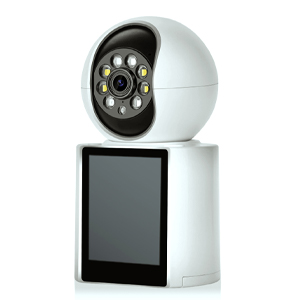
As a security-conscious homeowner, you know that threats don't clock out at sunset. When night falls, your property's vulnerability can feel heightened. This is where a security camera's night vision becomes not just a feature but a necessity.
But have you ever wondered how your camera manages to "see" in what appears to be total darkness? And what's the real difference between that grainy black-and-white footage and the full-color video you see in some advertisements?
Let's demystify the technology. We'll break down the three main types of night vision—Infrared (IR), Full Color, and Smart Mode—explaining how they work, their pros and cons, and even their impact on your energy bill.
What it is: This is the most common and traditional type of night vision. You recognize it by its characteristic black-and-white (or grayscale) footage. The tell-tale sign? Those small, reddish LEDs that glow around the camera lens in the dark.
How It Works:
Think of it like a covert operation. The camera itself emits a beam of infrared light, which is invisible to the human eye. The camera's sensor is specially designed to see this specific wavelength of light. It illuminates the scene with this "invisible spotlight," and the sensor captures the reflected light to create a clear, monochrome image.
Key Feature: It requires zero ambient light. It creates its own light source, making it effective even in complete darkness.
Power Consumption:
IR night vision is generally low to moderate in power usage. The LEDs don't consume a massive amount of energy, especially on cameras that use smart IR, which adjusts the intensity of the IR light based on the distance of the objects to prevent overexposure.
The Bottom Line:
Pros: Works in total darkness; cost-effective; widely available.
Cons: Footage is in black and white, which can make identifying specific colors (like car paint or clothing) impossible; the red LEDs can be noticeable to pests and savvy intruders.
What it is: As the name suggests, this mode allows your camera to capture video in color during the night, providing much richer and more identifiable details.
How It Works:
Unlike IR mode, a color night vision camera does not emit its own invisible light. Instead, it relies on amplifying the tiniest amounts of available ambient light. This could be from a distant streetlamp, a porch light, the moon, or even the glow from a neighbor's window.
These cameras use two key technologies:
A Large Aperture Lens (Low f-stop): Lets in as much available light as possible, like a wide-open pupil.
A Highly Sensitive Image Sensor (e.g., Starlight Sensor): This sensor is exceptionally good at capturing and processing very low levels of light, rendering the scene in color rather than reverting to greyscale.
Power Consumption:
This mode is typically very low power. Since it doesn't have to power an array of IR LEDs, it simply relies on its sophisticated sensor and lens to process existing light. The energy is spent on computation, not illumination.
The Bottom Line:
Pros: Provides color footage for better detail (e.g., "the car was blue, the jacket was red"); no glowing LEDs.
Cons: Requires some ambient light to function. In a pitch-black backyard with no lights, the image may be too dark or noisy, forcing the camera to switch to IR mode.
What it is: This isn't a separate technology but an intelligent fusion of the two modes above. Also known as "Auto-Switching" mode, it allows the camera to decide for itself which type of night vision is optimal.
How It Works:
The camera continuously assesses the lighting conditions in its field of view.
At dusk, it will prioritize Full-Color mode for as long as there is enough light.
Once the ambient light drops below a usable threshold, it will automatically switch to Infrared (IR) mode to maintain a clear picture, turning off the color processing and activating the IR LEDs.
This seamless handoff ensures you have a visual record 24/7 without any gaps in coverage.
Power Consumption:
This is the most dynamic mode in terms of power usage. It consumes power like a full-color camera when in color mode and like an IR camera when in black-and-white mode. The processing required for the constant analysis of light levels adds a small, constant overhead. Overall, it's designed for optimal performance, not necessarily for minimal power draw.
The Bottom Line:
Pros: "Set it and forget it" convenience; guarantees the best possible image quality regardless of changing light conditions.
Cons: Slightly more complex; the switching mechanism can sometimes be triggered by a temporary shadow, causing a brief mode change.
For Total Stealth & Complete Darkness: Stick with Infrared (IR). It's your reliable, all-weather night watchman.
For Maximum Detail with Some Light: Choose Full-Color. Ideal if you have a porch light, garden lamp, or decent street lighting.
For Ultimate Convenience and Coverage: Smart Mode is your best bet. It eliminates the need for manual switching and ensures you're always using the most effective technology for the moment.
Final Pro Tip: Consider your camera's placement and power source. For a battery-powered camera in a very dark area, using IR-only mode can help conserve battery life compared to a smart mode that might struggle to find light and switch back and forth frequently.
Understanding these differences empowers you to configure your home security system intelligently, ensuring that when the sun goes down, your peace of mind remains fully illuminated.
Copyright © 2023 INSEETECH LIMITED. All Rights Reserved.